Camille Saint-Saëns
Clarinet Sonata, Op. 167I. Allegretto
An autumnal, elegant Allegretto in flowing 12/8 — musical control and chamber partnership more than finger velocity.
At a glance
Clarinet and piano. The first movement is the most accessible of the four-movement sonata (Henle level 7 overall; Allegretto challenges are chiefly legato, tone, dynamic shaping, and 12/8 chamber coordination). Suits advanced high-school players studying refined French style, and college students preparing the full sonata as standard recital/jury repertoire.
Composer & composition
Composer & late wind sonatas
Charles-Camille Saint-Saëns (9 October 1835, Paris – 16 December 1921, Algiers) was a French composer, pianist, and organist, a child prodigy and lifelong stylistic conservative. In the last year of his life he wrote three wind sonatas for instruments he felt had been neglected: Oboe Sonata Op. 166, Clarinet Sonata Op. 167, and Bassoon Sonata Op. 168. In a letter to Jean Chantavoine dated 15 April 1921 he wrote that he was concentrating his “last reserves on giving rarely considered instruments the chance to be heard.” He had intended further sonatas for cor anglais and flute but did not live to complete the set.
The Clarinet Sonata was written in 1921, completed with the other two by June, printed in November 1921 only a month before his death at 86. He did not live to hear the premieres. Dedicated to Auguste Périer, clarinet professor at the Conservatoire de Paris. Jean Gallois called it the most important of the three — “a masterpiece full of impishness, elegance and discreet lyricism.” Henle notes the wind sonatas “hark back to the gallant style of the 18th century and thus approach the neoclassicism movement around 1920,” marked by “humour, wit and fine irony.”
About movement I (Allegretto)
The sonata has four movements and lasts about 16 minutes; the first-movement theme returns at the end of the fourth. Movement I is Allegretto in E♭ major, 12/8. The opening melody floats over a “sea of utterly calm eighth-note waves in the piano”; the form is ternary with a somewhat more active middle section oscillating around C minor. The clarinet enters as an anacrusis on the fourth beat of the first measure.
Structure / listening map
I. Allegretto
Allegretto · E♭ major, 12/8
Ternary form; pastoral, expansive theme over continuous piano eighth-notes; more active middle around C minor.
II. Allegro animato
Allegro animato · A♭ major, 2/2
Second movement of the full sonata (context).
III. Lento
Lento · E♭ minor, 3/2
Slow movement of the full sonata (context).
IV. Molto allegro (– Allegretto)
Molto allegro · E♭ major, 4/4
Virtuosic finale; first-movement theme returns at the close. Often listed at Grade 8 technical demand.
Reference performances
 1
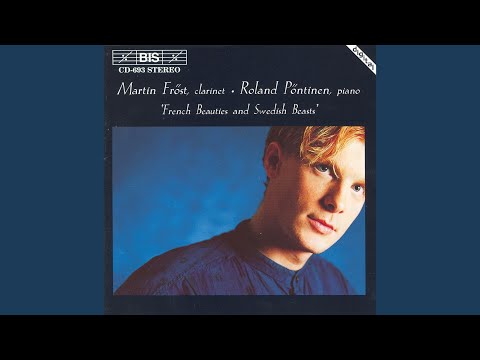
1Martin Fröst & Roland Pöntinen
Clarinet Sonata in E-Flat Major, Op. 167: I. Allegretto
Studio, BIS. Fröst: first prize Geneva 1997; Borletti-Buitoni Trust (2003); first clarinettist awarded the Léonie Sonning Music Prize (2014).
- Selection reason
- Highest performer prestige.
- Pedagogical value
- Benchmark for effortless legato and seamless register connection in the 12/8 flow; ideal model for tone color and unhurried phrasing.
- View count
- Not verified in the research environment
 2
2Paul Meyer & Éric Le Sage
Saint-Saëns: Sonata in E-flat major for clarinet & piano, Op. 167 — Meyer, Le Sage, 1991
Complete sonata (1991). Allegretto timestamps at 00:03 (3:48). Meyer studied at the Paris Conservatoire — authentic French-school style.
- Selection reason
- Performer prestige + authentic French-school style.
- Pedagogical value
- Idiomatic French reading — excellent for the “gallant,” light-textured Gallic sound, with the whole sonata for context.
- View count
- Not verified in the research environment
 3
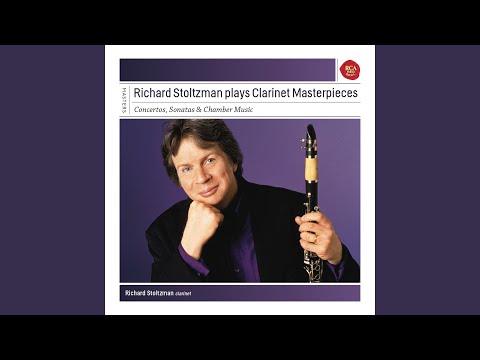
3Richard Stoltzman & Irma Vallecillo
Sonata for Clarinet and Piano in E-Flat Major, Op. 167: I. Allegretto
RCA/Sony studio. Two-time Grammy winner; first wind player awarded the Avery Fisher Prize (1986).
- Selection reason
- Performer prestige (major recording legacy).
- Pedagogical value
- Warm, singing American tone and expressive rubato; useful contrast against Meyer’s French approach.
- View count
- Not verified in the research environment
 4
4Annelien Van Wauwe & Lucas Blondeel
Camille Saint-Saëns: clarinet sonata in E-flat Major Op. 167 Annelien Van Wauwe & Lucas Blondeel
Live, deSingel Antwerp, 2016. ARD Munich prize-winner (2012); Borletti-Buitoni Trust (2018); Opus Klassik (2020).
- Selection reason
- Performer prestige + live-video value.
- Pedagogical value
- Live chamber performance for watching ensemble communication and breathing with the pianist in real time.
- View count
- Not verified in the research environment
 5
5James Campbell & John York
Camille Saint-Saëns : Three sonatas for solo wind instruments and piano Op. 166, 167 & 168 (1921)
Complete wind-sonatas set. Clarinet Sonata Allegretto begins at 11:10.
- Selection reason
- Relevance/context (hear all three wind sonatas) plus a distinguished chamber clarinettist.
- Pedagogical value
- Ideal for placing the Allegretto among its oboe and bassoon siblings and the shared “gallant” neoclassical style.
- View count
- Not verified in the research environment
Practice studio
Begin a practice plan →Performance notes
French Romantic / gallant style
Aim for impishness, elegance and discreet lyricism — nostalgic, “autumnal” warmth rather than heavy late-Romantic weight. Prefer clear, refined French-school sound; use vibrato sparingly and naturally.
Phrasing and rhythmic weighting
Saint-Saëns felt beat one should be stronger than beat two. Keep 12/8 flowing and pastoral; let the theme sing expansively rather than drag. Slight ritenuti only; let the music determine nuance choices.
Common mistakes
Treating the opening as “waiting for the hard part” → create motion and micro-phrase conversation. Losing subdivision → constant internal eighths + score study. Starting diminuendo too soft → crescendo-then-relax. Over-vibrating / heavy tone → restraint. Only isolated fragments → whole phrases + intentional breaths.
Difficulty & suitability
G. Henle rates the Clarinet Sonata Op. 167 at level 7 (“difficult”) on its 1–9 scale, with ABRSM Grade 6 and Grade 8 cross-references depending on movement. The Allegretto is generally the most accessible of the four: challenges are sustained legato, tone control, dynamic shaping into the upper register, and chamber coordination in flowing 12/8 rather than extreme finger velocity (concentrated in the virtuosic finale). Advanced high-school players can approach movement I as refined legato and French-style study; college players use the full sonata as standard recital/jury repertoire. Teachers can use it for subdivision, phrase-building, dynamic pacing, and ensemble balance.
Sources & notes
Compiled July 17, 2026. View counts change over time; verify before citing in class.
Compiled July 17, 2026. YouTube view counts could not be retrieved reliably in the research environment for this work; every view count is reported as n.a. rather than estimated. Performer names, titles, channels, and URLs were verified from fetched video pages.